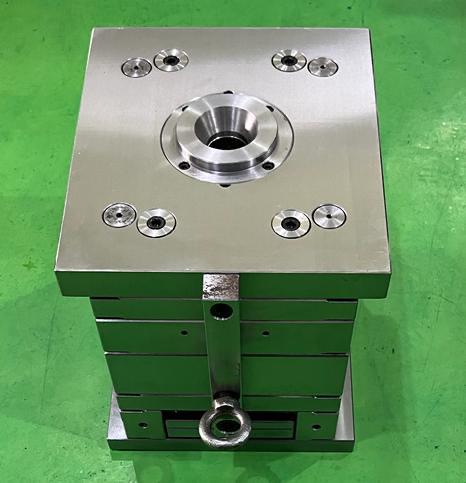
Aluminium 6061
CNC Machining Service

Upload your 3D model and get a quote for precision CNC machined Aluminium 6061 parts. Strong, lightweight and production ready components for prototypes, pilot runs and repeat production.

Certifications: ISO 9001 : 2015, IATF 16949:2016.
Amuse3D delivers precision CNC machined Aluminium 6061 components with controlled manufacturing, dimensional inspection and material traceability for consistent prototype and production requirements.

Aluminium 6061. Built for Real Engineering Applications.

Some materials are ideal for visual prototypes. Others are selected to perform in actual products.

Aluminium 6061 is one of the most versatile heat treatable aluminium alloys for engineering applications. It combines useful structural strength with corrosion resistance, toughness, weldability and suitability for machining.

For CNC machined parts, Aluminium 6061 T6 is a practical choice for components that need strength without unnecessary weight. It is widely suited to applications such as brackets, housings, fixtures, frames, machine components and structural parts.

“When a part needs a practical balance of strength, weight and manufacturability, Aluminium 6061 is often the place to start.”

At Amuse3D, Aluminium 6061 parts are manufactured using production grade CNC machining processes for prototypes, functional testing and production applications.

Our CNC capabilities support milling, turning and complex machining requirements. This gives engineers the flexibility to manufacture simple components as well as detailed geometries, critical fits and production ready assemblies.

Unlike tooling dependent manufacturing processes, CNC machining allows designs to be manufactured directly from digital CAD files. This makes it easier to test designs, modify features and progress from prototype quantities to repeat production.

From product development teams to automotive, robotics, industrial equipment, electronics and other engineering applications, Aluminium 6061 offers a versatile starting point for precision metal components.

Test Our Aluminium 6061 Machining Quality Against Anyone in the World.

Production Grade CNC Machining for Aluminium 6061

From a single prototype to repeat production runs, Aluminium 6061 parts are manufactured through Amuse3D's CNC machining capabilities.

Our manufacturing setup supports CNC milling, CNC turning and multi axis machining for components with complex geometries and precision requirements.

What does this mean for your project? You can manufacture prototypes, engineering validation parts and production components through one manufacturing partner.

  • Available Materials: Nylon PA12, Nylon PA11, Nylon PA12 Smooth

  • Available print modes: Performance (+10% strength), Balanced, and Custom (engineered specifically for your application and product).

  • Standard Lead time (at your door) : 3 to 5 days within India,  4 to 7 days Worldwide. We extensively ship MJF parts to the USA, Switzerland, Japan and many other countries in the EU.

We don't just ship MJF parts worldwide. We ship confidence.

Chennai Shipping globally from India USA/ North America/ Canada Germany / Europe / UK Japan/ Korea China / Hong Kong / APAC Australia New Zealand

Why should I trust Amuse3D over another MJF supplier?

Precision-Controlled Manufacturing Environment: Every variable matters. Temperature. Humidity. Powder quality refresh ratio. Machine calibration. Build orientation. Inspection. Most print shops focus on the printer. We engineer the entire manufacturing environment, so every part is produced with the consistency, repeatability, and quality expected from a production supplier. Because world-class parts aren't created by chance. They're engineered, build after build every day.

Ultra-Fast Production & Shipping: Our 5 machines with dedicated emergency builds. We dispatch in 48–72 hours for most parts.

Our Guarantee: Not happy? We'll fix it. If your part doesn't meet the specified specs, we'll reprint, replace, or refund it promptly and without fuss.

Competitive Pricing: Our global scale allows significantly lower cost per part, while maintaining premium quality

Advanced HP MJF Technology 5620 enabled with cusomt print modes: Your parts are produced using the latest HP 5620 system with top mechanical properties, isotropic strength, and excellent finish.

Surface finishes for MJF 3D Printing​

We offer a range of surface finishing options, sometimes to mimic moulded finish. These finishes enhance both the aesthetic and functional qualities of printed parts. Besides, we have other advanced post-processing techniques

Raw Split and Joint
After Post-Processing

MJF Express

Your high-quality MJF 3D printed parts dispatched in 24 hrs.

Choose our express option for faster delivery of urgent prototypes or low-volume parts.  How? We reserve emergency short builds for last-minute jobs. Order by 2:30 Pm (IST), and we’ll ship your parts within 24 hours. Available material: PA12.

Instant Quote MJF 3D Printing Service with 24/7 Online Ordering

Place your orders easily through our 24/7 online platform.
Simply upload your design to receive instant MJF printing quotes.
Our experienced engineers are available to help optimize your designs for the best printing results.

Use code HELLO10 at checkout to enjoy 10% off your online order.

Just 3 steps to get your parts in hand
01

Upload your file

Upload your 3D CAD model to our instant quoting platform and get started in minutes.

02

Configure your parts

Select material, finish, quantity, and lead time based on your application needs.

03

Production & delivery

We manufacture, inspect, and ship your parts with consistent quality and reliable lead times.

Amuse 3D - The Factory Behind Your Next Million Parts.

Engineering, Quality, and Reliability – that’s what differentiates us. With our automotive production experience, we have attained IATF 16949 qualification, the highest level of quality in working with advanced standards and traceability. We maintain this standard consistently with our MJF 3D Printing, as it reflects our commitment to whatever we do. We are proud to be HP-certified partners worldwide as Multi Jet Fusion Production Professionals for printing advanced quality parts.

General inquiries? Questions about engineering? Do you seek support with your design?
Testimonial

Most accurate MJF PA12 parts I've gotten from any vendor. The surface finish almost matched the injection molding finish. The best part is it got delivered to PHX in 5 days with their economy option.
Kevin

Senior Mechanical Engineer
USA

Working with a competent team is one thing; working with a competent team who is also passionate about what they do is quite another. Amuse is the latter, where they make no compromises on product quality but still manages to bridge the cost-quality gap. Whatever challenges you throw at them, they always find an engineering solution within their domain and show no reservations, to venture outside their comfort zone. I strongly recommend the team at Amuse to create a product solution in a sustainable environment.

Sanju Sanudas

Senior Engineer, Automotive
Polyhose India

As an industrial designer from Toronto, I had a fantastic experience with Amuse 3D’s HP MJF printing. The prints were high-quality, the process was seamless, and I received my order within just 5 days! Excellent service at a great price—truly value for money! Highly recommended!

Kiran Senthilnathan

Industrial Designer
Canada

HP MJF PA12- Great service, fast, and clean.

Clint Santos

Sourcing
Philippines

I ordered 2 parts in high quantities, which differ only by a very small hole. The two variants were traced, packaged separately, and delivered very quickly and with high quality. Thank you very much!

Bernhard März

VP
Daimler

Why engineers choose MJF over SLS, FDM, and SLA?

Feature
Strength
Cost
Surface Finish
Minimal Features
Accuracy
MJF (Multi Jet Fusion)
High; suitable for functional parts due to robust material properties
Moderate $$ ; higher than FDM but generally lower than SLS and SLA for batch production.
Smooth with minimal visible layers; superior surface quality compared to FDM and SLS
Fine details possible; better than FDM, comparable to SLS
High; precise control over part dimensions with consistent results.
SLS (Selective Laser Sintering)
High; good for functional parts, slightly less strong than MJF
High $$$; due to material and process costs
Slightly grainy due to powder texture; smoother than FDM
Good for small features, slightly less defined than MJF
High; similar to MJF, slightly less accurate due to thermal effects
FDM (Fused Deposition Modeling)
Moderate to high; dependent on material print settings
Low $; materials and equipment are relatively inexpensive
Visible layer lines; requires post-processing for smooth finish
Larger minimum feature size due to nozzle size; less detailed than MJF and SLS
Moderate; less accurate than MJF and SLS, affected by material shrinkage.
SLA (Stereolithography)
Moderate, resin can be brittle, but specialized resins offer higher strength
Moderate $$ to high $$$$; resin costs and post-processing add to overall expense because of the support structure
Very smooth and detailed; best surface quality among the four
Excellent; capable of excellent features and intricate details
Very high; extremely accurate, best for intricate and detailed parts

Enjoy 10% off your first online order! Use code HELLO10 now!

Frequently Asked Questions

How to design connecting and moving Parts for MJF?

Sometimes two printed parts need to fit together to make the final product. The gap between the interface areas of these parts should be at least 0.4 mm (with a tolerance of ±0.2 mm for each part) to make sure they fit together correctly.

As a general rule, there should be at least 0.7 mm of space and clearance between the faces of printed assemblies. For parts with walls that are at least 30 mm thick, there should be a bigger gap between each side to make sure they work rightIf the walls of the parts are less than 3 mm thick, the space between parts printed as assemblies can be as small as 0.3 mm. However, this depends on the design, and you may need to work with the manufacturer to make sure the parts work well.

  • Gap between fitting parts: ≥ 0.4 mm
  • Clearance for moving parts: ≥ 0.7 mm

Tip: Ensure 0.3–0.7 mm clearance depending on wall thickness.

How to design connecting and moving Parts for MJF?
Minimum gap between connecting parts from HP's recommendations
How to design connecting and moving Parts for MJF?
Minimum gap between moving parts From HP's recommendations

How Aspect Ratio Impacts Cantilever Strength in 3D Printing

When printing a cantilever, the minimum wall thickness depends on the aspect ratio, which is the length of the cantilever divided by its width.

The aspect ratio should be less than 1 for a cantilever that is less than 1 mm wide. There aren't any specific recommendations for widths of 1 mm or more. It is best to make the walls thicker or add ribs or fillets to parts with a high aspect ratio to make them stronger.

Creating cantivers for MJF parts
Cantilevers

Design Guidelines for Minimum Wall Thickness in MJF Printing

In general, the minimum wall thickness for short walls that face the XY plane is 0.3 mm, and for short walls that face the Z plane, it is 0.5 mm.

What is the minimum wall thickness for MJF parts?
Minimum wall thickness of HP MJF 3D Printing

What is MJF 3D Printing?

Our HP Multi Jet Fusion (MJF) technology at Amuse 3D gives us a one-of-a-kind way to 3D print that is different from other additive manufacturing processes. MJF is much more accurate than many other 3D printing methods and makes high-quality parts up to ten times faster. This helps you get items to market faster.

MJF makes things one layer at a time, just as other powder-based methods. It doesn't use lasers; instead, it employs fusing and detailing chemicals that are put down across each cross-section, similar to how an inkjet printer works. Then, these cross-sections are fused together with very high heat, which bonds each layer evenly and well. Selective Laser Sintering (SLS), Stereolithography (SLA), and Direct Metal Laser Sintering (DMLS) are all methods where build time can change based on the shape. MJF, on the other hand, has consistent layer times, enabling faster, more predictable output.

MJF is a strong and adaptable option in Amuse 3D's manufacturing array. It's great for making functional prototypes, small batches, and even as a bridge to injection molding. It's a cheap solution to test, iterate, and make components quickly that has great surface quality, strength, and scalability.

Learn more about MJF technology here.

Design, prototype and mass-produce - all in one integrated factory