3D Printing for Robotics
Precision | Certified | Production-Ready Parts (from 1 to 1,000 units) in 2–4 days
.avif)
Why robotics teams specify HP Multi Jet Fusion and what that means for your next part.
MJF wins robotics work for reasons that are mechanical and economic, not aesthetic: parts come out with genuinely isotropic strength, the powder bed itself acts as support so internal channels and moving assemblies print without extra tooling, whole layers fuse at once instead of tracing point-by-point, and up to 80% of unused powder goes back into the next build
Production Scale & Expertise
From one-off validation components to batch production of hundreds of 3D printing robotics parts, we support serial manufacturing for robotics OEMs, integrators, automation Tier-1/Tier-2 suppliers, and humanoid and mobile-robotics teams. Our team executes 3D printing in robotics industry programs to hit deployment dates and quality gates
Why Choose 3D Printing in the robotics Industry?
Rapid Prototyping & Iteration – Move from CAD to functional 3D printing robotics parts in hours for fit, form, and performance checks without tooling.
Lightweight Optimization – Apply lattices/topology for up to XYZ% mass reduction in robotics 3d printing, improving efficiency and range.
Part Consolidation – Merge assemblies into single 3d printing automotive parts to cut piece count, fasteners, and failure points.
Isotropic mechanical strength – A part printed in MJF has close to the same strength no matter which direction you load it — not just along the print layers
.avif)
Your Partner for Robotics 3D Printing
Engineering rigor, DFAM expertise, and process control drive our 3d printing in robotic industry results. Our engineers and quality teams understand GD&T, tolerance stacks, and PPAP deliverables for robotic 3d printing across prototype, pilot, and series.
Shipping globally from India with quality, love, and care!
A gripper isn't a bracket. It's a moving mass with a duty cycle.
Every gram on an arm-mounted part gets accelerated and decelerated thousands of times a shift.
Less mass there means less inertia, less motor strain, and more of the arm's rated payload actually available for the part it's holding. Most manufacturing shops treat a robotics bracket the same as any structural part. It isn't. It has to survive continuous duty cycles, keep tight tolerances at a mounting interface, and stay light enough that it doesn't eat into payload capacity or slow the arm's rated speed.
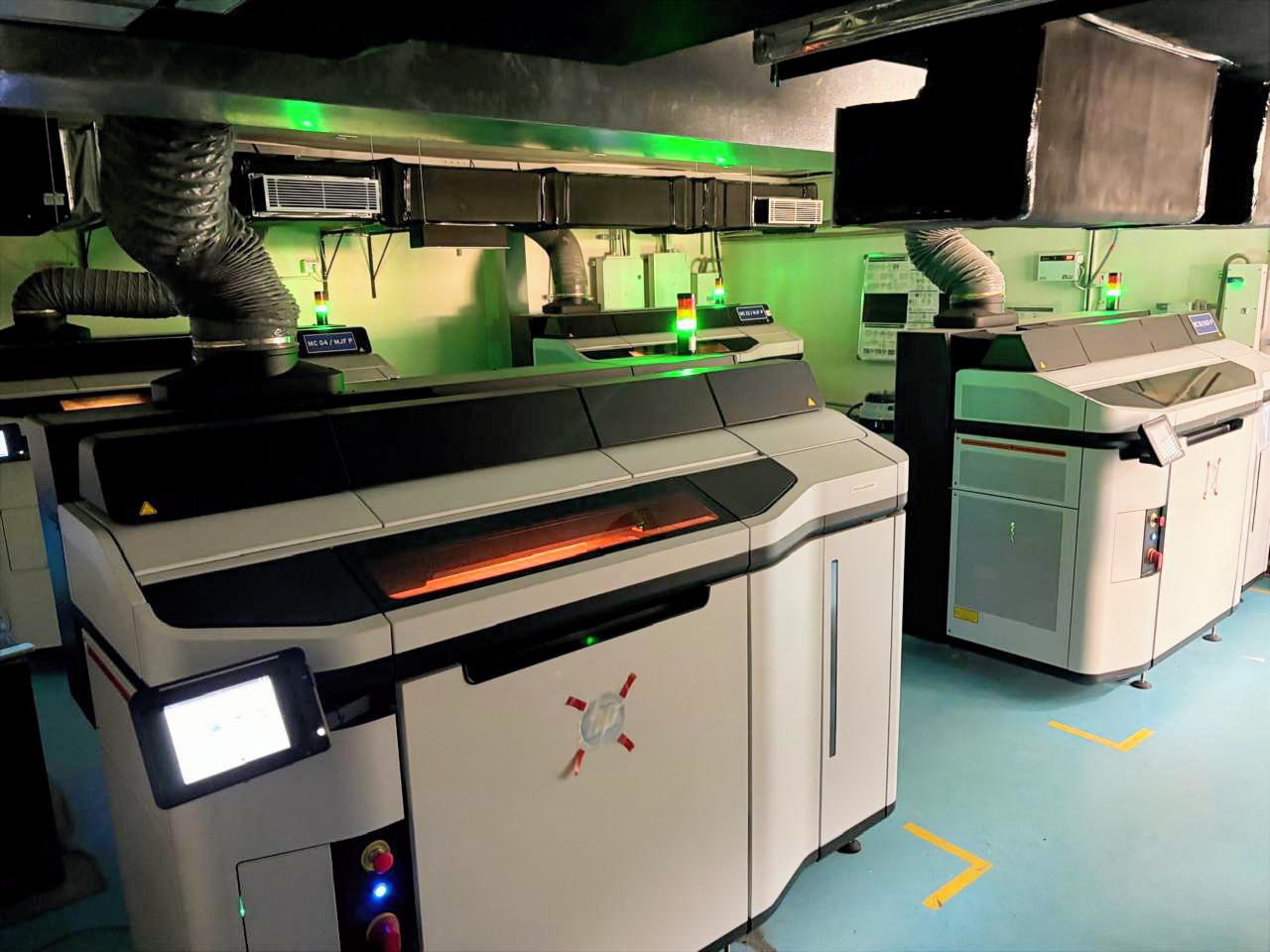
We run this on HP MJF 5620, 5210 systems in isotropic PA12, PA12S and PA11 nylons with genuinely consistent strength in every direction, not just along the print axis out of a 50,000 sq. ft. integrated factory in Chennai that also houses injection moulding and CNC, so a part can move from prototype to serial production without changing suppliers

3D Printing in Robotics - Where this gets used
Arms - Industrial arm brackets & mounts
EOAT Grippers & end-effectors
Mobile AMR / AGV chassis & housings
Legged - Hexapod & legged-robot joints, Humanoid limb & hand components
Want on-demand spares to eliminate downtime with 3D printing in robotis industry
.avif)
.avif)
Try us before you commit a single dollar to production.
Upload your CAD file and we'll print your first sample in your chosen material and finish — free. Hold the actual part, check the fit, feel the finish.
.avif)
General inquiries? Questions about engineering? Do you seek support with your design?
.png)
Most accurate MJF PA12 parts I've gotten from any vendor. The surface finish almost matched the injection molding finish. The best part is it got delivered to PHX in 5 days with their economy option.

Kevin
Working with a competent team is one thing; working with a competent team who is also passionate about what they do is quite another. Amuse is the latter, where they make no compromises on product quality but still manages to bridge the cost-quality gap. Whatever challenges you throw at them, they always find an engineering solution within their domain and show no reservations, to venture outside their comfort zone. I strongly recommend the team at Amuse to create a product solution in a sustainable environment.

Sanju Sanudas
As an industrial designer from Toronto, I had a fantastic experience with Amuse 3D’s HP MJF printing. The prints were high-quality, the process was seamless, and I received my order within just 5 days! Excellent service at a great price—truly value for money! Highly recommended!

Kiran Senthilnathan
HP MJF PA12- Great service, fast, and clean.

Clint Santos
I ordered 2 parts in high quantities, which differ only by a very small hole. The two variants were traced, packaged separately, and delivered very quickly and with high quality. Thank you very much!

Bernhard März
Frequently Asked Questions
Which robotics parts are best suited to 3D printing?
End-effectors, grippers, arm brackets and mounts, AMR/AGV chassis panels, sensor housings, cable management, and jigs/fixtures used to build or test robots
Can printed parts handle continuous duty cycles?
PA12 and PA11 via HP MJF produce isotropic parts with consistent mechanical properties in every direction, not just along the print layers, which is what continuous, repetitive motion actually demands.
Do you support IATF/PPAP-style documentation for robotics OEMs?
Yes - we provide ISO 9001:2015, IATF-aligned process control, PPAP packages (dimensional reports, material certs), and traceability for 3D parts.
How much weight can lattice optimization actually save on a robot part?
It depends on the part's load path and geometry, but 10–30% mass reduction is a realistic target range while reinforcing the areas that carry real stress. Use the calculator above to see what that means for your own part and payload
.avif)