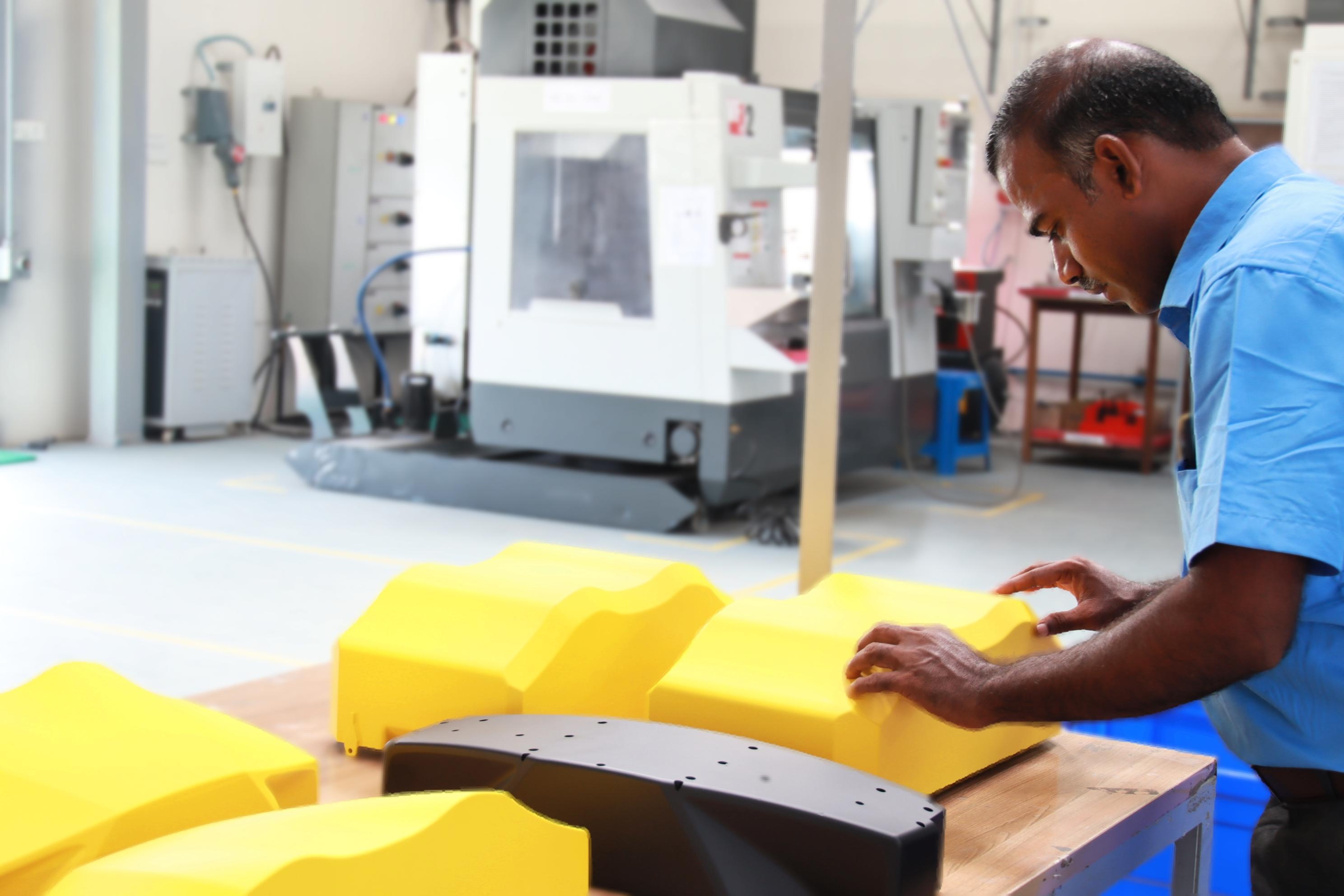
A Practical Guide to Rapid Prototype CNC Machining for Product Teams
Rapid prototype CNC machining turns a CAD file into a functional metal or plastic part in days, not weeks, without a single rupee or dollar spent on tooling. If your product needs a prototype that behaves exactly like the finished part under real stress, heat, and load, this is the process built for that job. This guide covers what rapid CNC machining is, when it beats 3D printing or injection moulding, what materials and tolerances you can realistically get, and how Amuse3D delivers CNC prototypes across India, the US, the UK, and beyond.
What Is Rapid Prototype CNC Machining?
Two ideas make up this process.
Rapid prototyping is the fast manufacture of a physical part straight from CAD data, so you can test form, fit, and function before you spend money on tooling.
CNC machining is Computer Numerical Control machining, a subtractive process. A machine cuts material away from a solid block, guided by code generated from your 3D model, until only the finished part remains.
Put the two together and you get rapid prototype CNC machining: end-use quality prototypes in days, cut from the same block of material your final product will use. Because nothing is layered or melted, the part keeps the full mechanical integrity of the raw stock. That's the real difference between rapid CNC machining and additive processes like 3D printing.
How Rapid CNC Machining Works
It starts with your 3D model. That file becomes G-code, the instruction set a CNC machine reads to move its cutting tools. From there, a 3-axis, 4-axis, or 5-axis CNC machine mills the part out of a solid billet of metal or plastic, following the exact path your file specifies.
Because it's subtractive rather than additive, the part never passes through a molten or powdered state. It's cut, not built up, which is part of why a CNC-machined prototype can hold tolerances as tight as ±5 to 10 microns (roughly ±0.005 to 0.01mm) on critical features, a precision level in the same territory as the ISO 2768 framework most engineering drawings already assume for general dimensions.
When Rapid CNC Machining Makes the Most Sense
Four scenarios where rapid CNC machining is the better call over 3D printing:
- Strength under load: the part has to survive real mechanical stress, vibration, or heat, not just look right on a shelf.
- Production-grade material: you need the exact alloy or polymer your final part will ship in, not a printable stand-in resin.
- Tight tolerances or a machined finish: you're chasing a fit or a surface that layer-built parts can't reliably hit.
- Functional testing: the prototype has to behave like an injection-moulded or cast part in an actual mechanical test, not just a visual mockup.
Rapid CNC Machining vs. 3D Printing vs. Injection Moulding
Which one you pick usually comes down to where you are in development.
Early concept, complex shape, quick "does this feel right" check? 3D Printing wins on speed and design freedom, especially while you're still iterating fast before locking the geometry.
Need the part to behave like the real thing, in the real material, at real tolerances? Rapid CNC machining is your validation step, and it's where CNC pulls ahead of 3D printing for metal parts, since machined metal simply outperforms printed plastic in structural work.
Ready to make thousands of units? That's Injection Moulding territory. But nobody skips straight to a mould without validating the design on a CNC prototype first. Rapid CNC prototyping is the checkpoint between "this looks right" and "we're ready to tool up."
Materials You Can Actually Get
This is where rapid machining earns its keep. You're not limited to whatever resin your printer happens to take.
Metals: Aluminium 6061 through 7075, stainless steel, mild steel, brass, and copper.
Plastics: PEEK, Delrin, and nylon, alongside standard engineering plastics.
Each behaves differently under a cutting tool. 6061 machines easily and takes anodizing well, which is why it shows up in everything from enclosures to brackets. Aluminium 7075 trades some of that machinability for a noticeably higher strength-to-weight ratio, which is why it turns up more often in high-load parts. SS 304 holds up where corrosion resistance actually matters.
If your part is headed for Aerospace Parts applications, this material flexibility is the whole point: you test in the actual alloy your part will eventually ship in, not a filler material.
What You Get With Rapid CNC Machining
Precision: tolerances as tight as ±5 to 10 microns (±0.005 to 0.01mm) on critical features, with general dimensions following the ISO 2768 tolerance framework most drawings already assume.
No tooling cost: unlike moulding, there's no mould to cut and no tooling investment to recover before you even see a part.
Speed: CNC prototype orders can dispatch within 24 hours of confirmation, with standard delivery running 3 to 7 days within India and 3 to 10 days internationally.
Part size: machines handle parts up to 800 × 500 × 500mm, so this isn't limited to small brackets and fixtures.
Versatile: from Medical Devices housings that need a specific engineering plastic to Drone Frames that need to survive a crash, rapid CNC prototyping covers a wide range of end-use testing needs.
Choosing a Rapid CNC Prototyping Partner
Not every CNC shop treats prototyping the way it treats production runs. Look for a partner who reviews your CAD file under Design Application before it hits the machine. Good DFM feedback, catching a thin wall or an awkward hole before machining starts, saves you time and cost. It's the difference between a shop that just runs your file and one that improves your part.
Conclusion
If your prototype needs to survive testing in the material your product will actually ship in, rapid prototype CNC machining is the tool built for exactly that job. It skips tooling costs, holds tight tolerances, and gets you a functional part in days rather than weeks, in aluminum, stainless steel, PEEK, or whatever your final part demands.
At Amuse3D, CNC machining sits alongside our 3D Printing and Injection Moulding capabilities under one roof, so your project can move from prototype to production without changing suppliers. Whether you're validating an aerospace bracket or a medical housing, our team can talk through tolerances, materials, and timelines before you commit to a design.
Ready to move forward? Request an Instant Quote or Contact Us to get your CNC prototype moving.
Frequently Asked Questions
1. Is CNC machining more expensive than 3D printing for prototypes?
Usually, yes, per part. CNC machining involves material waste and setup time that 3D printing doesn't. But for structural parts that need to survive real stress or heat, the extra cost buys you a prototype that actually predicts how your final part will perform, something 3D printing often can't.
2. What's the typical lead time for rapid CNC machining?
Within India, standard delivery runs 3 to 7 days. Internationally, expect 3 to 10 days, with CNC prototype orders typically dispatched within 24 hours of confirmation. Complex geometries or unusual finishes can push that timeline slightly.
3. How do I choose between rapid CNC machining and 3D printing for my prototype?
If you're still iterating on shape and just need to check fit or visual appeal, 3D printing is faster and cheaper per iteration. Once you need the actual production material, tight tolerances, or a part that has to survive a mechanical test, switch to rapid CNC machining.
4. What tolerances can rapid CNC machining actually hold?
On critical features, tolerances as tight as ±5 to 10 microns (±0.005 to 0.01mm) are achievable, well beyond what layer-built processes can reliably deliver. General dimensions typically follow the ISO 2768 tolerance framework unless a drawing specifies tighter requirements.

