The PPAP Production Part Approval Process From First Part to Full Manufacturing
A customer email arrives: "PPAP required before we release this part to production." PPAP (Production Part Approval Process) is documented proof that a part, and the process behind it, is ready for real production, not a one-off sample.
If you've just searched what is PPAP, here's the full picture: the five levels, the 18 elements, how approval runs, where it gets rejected, and how it applies to 3D-printed and injection-moulded parts as much as automotive stampings.
What Is PPAP in Manufacturing?
PPAP meaning: the PPAP Production Part Approval Process is the quality framework a supplier uses to show a new or changed part is understood, documented, and ready for mass production.
PPAP in manufacturing began with vehicle makers, published by the Automotive Industry Action Group (AIAG).
It now reaches plastics, electronics, and 3D-printed and moulded components, wherever a customer wants structured quality evidence before approval to ship production volume.
PPAP documents what a part is, how it's made, and how it was checked. Proving a supplier meets the customer's quality standards is the entire point: a PPAP package is design records, process documents, and inspection results a supplier compiles and a customer reviews before committing to an order.
Why OEMs Request PPAP From Suppliers
Understanding PPAP starts with the purpose, not the paperwork. The PPAP process confirms two things before an OEM commits: that the customer's design record and specification requirements are properly understood.
It also confirms that the manufacturing process is capable of consistently producing conforming parts during an actual production run at the quoted rate.
PPAP sits downstream of APQP (Advanced Product Quality Planning), the framework OEMs use to plan product quality from design through launch; PPAP is the final checkpoint confirming that plan worked.
Beyond automotive, aerospace, medical device, and industrial manufacturers have adopted PPAP-style submissions: does this supplier's process meet all customer requirements every time?
The 5 PPAP Submission Levels Explained
The five PPAP levels represent different levels of evidence the customer wants to see, not different quality bars a part has to clear.
Level 3 is the default for most new launches, giving complete data without an on-site visit. The top tier adds an in-person review of initial process studies and performance data, usually for safety-critical parts.
All 18 elements stay on file regardless of level, and the level requested depends on design requirements, quality history, and proximity to volume production.
The 18 PPAP Elements, Grouped Simply
PPAP covers production parts and bulk material. This PPAP 18 elements breakdown groups all 18 PPAP elements into four: design records, process documents, inspection results, PSW sign-off.
Not every element reaches the customer; the level decides that. The control plan and process flow diagram should match the PFMEA, since mismatches trigger rejections. Dimensional results typically come from a run of at least 30 parts.
How the PPAP Approval Process Works
The PPAP process moves through five stages: your PPAP checklist for what happens after submission.
- Trigger: a new part, a design revision, a tooling change, a plant relocation, or a quality issue starts a PPAP submission.
- Compile: the supplier gathers design records, process documents, and inspection results for the level requested.
- Submit: the package goes out as PDF file sets, with a signed PSW, the quality assurance signature declaring the parts represent full production.
- Review: the customer's quality and engineering teams check documentation, dimensional results, and process capability against the control plan and PFMEA.
- Disposition: Approved (customer approval to ship at the quoted rate), Interim Approval (temporary shipment against a corrective action plan), or Rejected (no shipment until resubmission).
Keep PPAP documents organized by element number so a reviewer can trace it to evidence quickly.
PPAP vs First Article Inspection
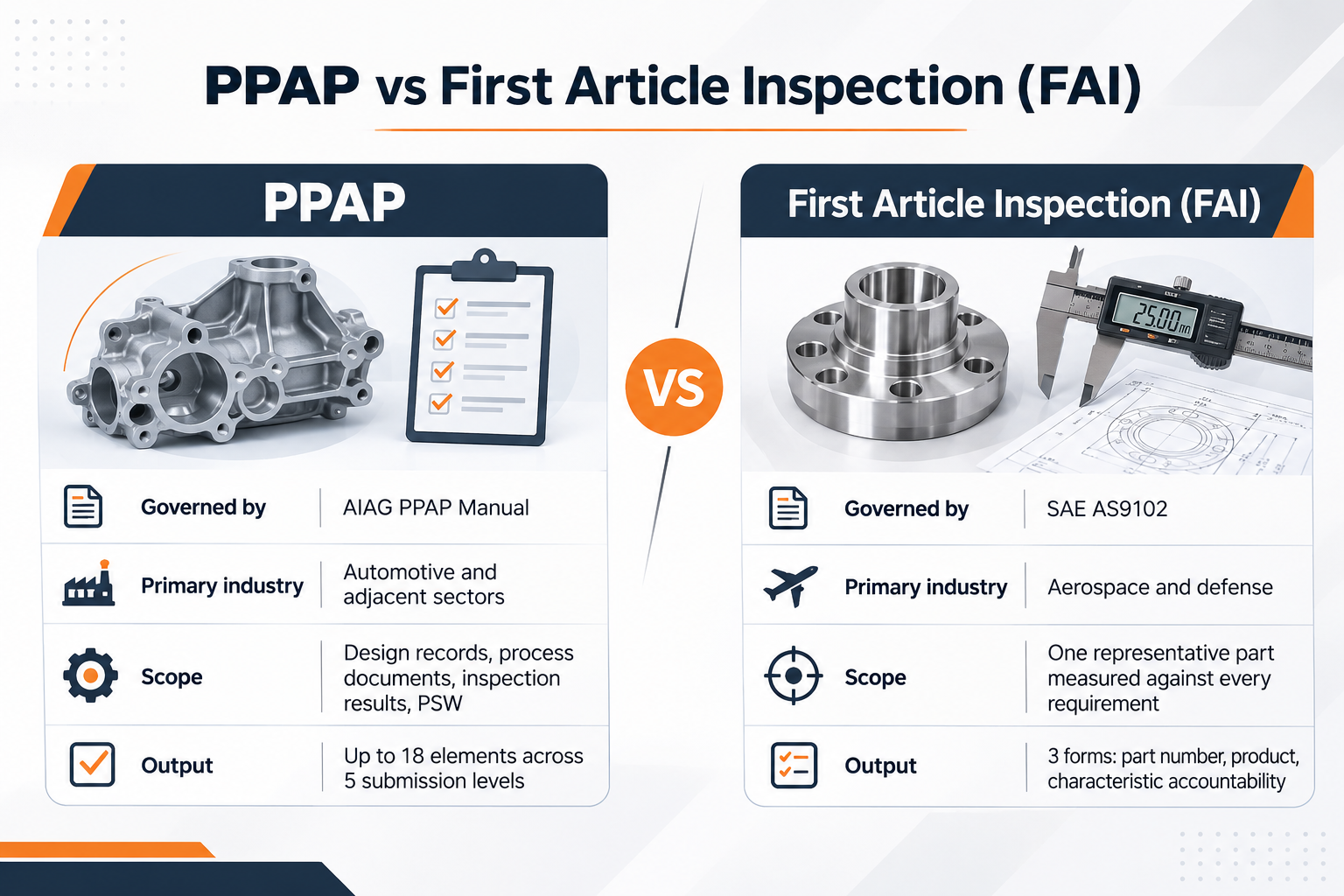
PPAP is used in the automotive industry as the default production gate; First Article Inspection (FAI) plays the same role in aerospace under AS9102. PPAP validates the process, FAI validates the part.
The two overlap in practice: dimensional results in a PPAP package function like an FAI report, and many packages contain one as element 9.
Aerospace under AS9102 generally skips a full automotive-style PPAP, while automotive customers almost always expect one. If a customer says "first article," confirm they mean a full PPAP submission.
Common Reasons PPAP Submissions Are Rejected
Most rejections come down to inconsistent PPAP documents rather than a genuinely bad part.
- Mismatched process flow diagram, PFMEA, and control plan, checked side by side.
- Initial process studies short of the customer's minimum capability, commonly a Cpk near 1.33 for new tooling.
- Material or performance test certificates that don't match the print callout, or are missing.
- An unsigned, outdated, or incomplete Part Submission Warrant.
- Prototype data submitted instead of data from full production, at the quoted rate.
- Open non-conformance reports carried into full production undisposed.
A PPAP can also return an interim approval, shipping briefly against a corrective action plan. Treat the 18 elements as one story: tracing design record to control plan to PSW approves faster.
PPAP for Low-Volume, 3D-Printed and Injection-Moulded Parts
PPAP applies to 3D-printed and injection-moulded parts the same way it applies to stampings: the 18 elements don't change, only how the evidence gets generated does.
For 3D printing in automotive and other low-volume programs, the process map still has to describe the real workflow, and a control plan still has to name the inspection points.
The gap shows in initial process studies: a low-volume program can struggle to match a stamping line's statistical run, so customers often accept a modified sampling plan for genuine low volume manufacturing rather than waiving the element.
Binder jetting has already passed a Level 3 PPAP for an automotive customer.
For injection moulding services, the same 18 elements apply, with additions like mould qualification records inside the existing groups.
What to Request From Your Manufacturing Supplier
Before accepting a PPAP package, ask for three things beyond the PSW:
- Inspection reports with raw measurement data, not just a pass/fail summary, produced on request rather than assembled only for one submission.
- Material certificates tied to the specific lot, backed by the quality tools used to generate them: gauge R&R studies, calibrated equipment.
- Ongoing quality planning, not a one-time snapshot. Ask whether the supplier can maintain tight tolerances in production at the volumes you need, and whether they'll run a sample before full production before a large order.
These questions matter more for new, 3D-printed, or moulded parts: less production history to fall back on, and quality requirements need equal understanding on both sides.
Amuse3D's Quality Documentation and Inspection Support
At Amuse3D, our quality system runs under ISO 9001:2015 and IATF 16949:2016, with a 0 PPM rejection rate and 99% on-time delivery across 1,000+ clients in 30+ countries.
That IATF certification is the same automotive quality management standard PPAP sits inside, so when a customer asks for PPAP-style documentation, the underlying quality policy and inspection records already exist.
Amuse3D's Oragadam factory runs India's largest HP MJF fleet alongside injection moulding and CNC lines, so records come from one system, not several subcontractors.
Conclusion
PPAP meaning aside, the discipline is simple: prove the design is understood, prove the process is controlled, prove the parts measure up, and sign the PSW. One tier is the default for most launches, and all elements should stay on file even when only some are submitted.
Amuse3D already packages PPAP documentation alongside APQP and FMEA for automotive suppliers like Polyhose India. If a PPAP request is coming up, get an instant quote or talk to our engineering team about what it will need.
Frequently Asked Questions
1. What is PPAP in one sentence?
PPAP, or Production Part Approval Process, is documented proof that a supplier's design and process are ready to meet customer requirements at full production volume.
2. What is a PPAP checklist?
It's the PPAP 18 elements list: complete, submitted, or kept on file.
3. What is a Part Submission Warrant (PSW)?
The PSW is the one-page declaration tying a PPAP package together: reason for submission, level submitted, and sign-off that parts conform.
4. Is PPAP the same as APQP?
No. APQP is the broader planning process from design through launch; PPAP is the final approval step inside it.
5. Does PPAP apply outside the automotive industry?
Yes. Aerospace, medical device, and industrial suppliers increasingly use PPAP-style submissions, though aerospace often defaults to AS9102 instead.

