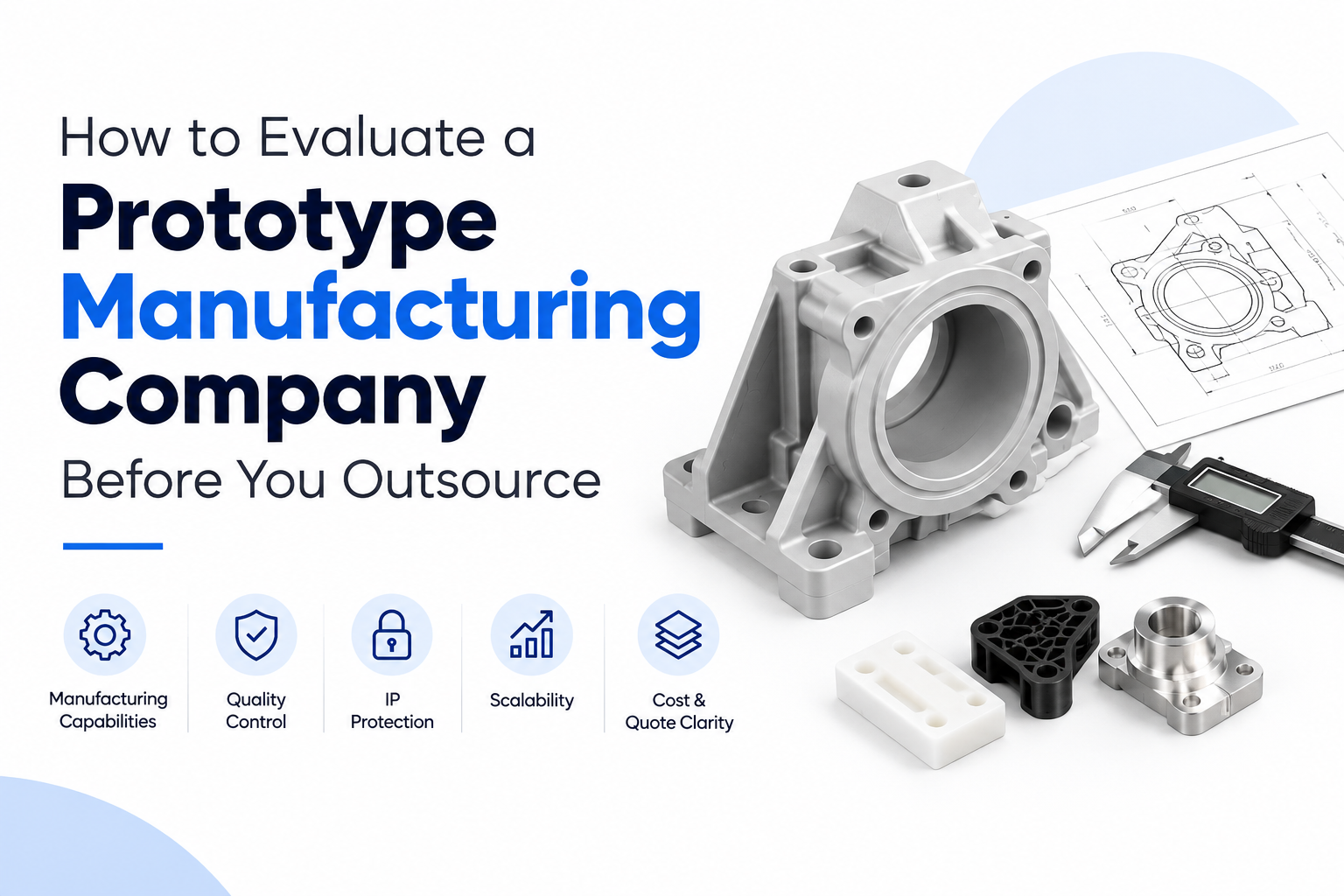
The Buyer's Guide to Choosing the Right Prototype Manufacturing Company
Outsourcing to the wrong prototype manufacturing company costs more than a reprint. A poorly vetted shop can hand back parts that fail under load, mishandle your CAD files, or miss your deadline. This guide covers what to check before a quote becomes an order: capability, quality control, IP protection, and scalability.
Why the Right Prototype Manufacturing Company Matters
A prototype answers a question: does the design work, does it fit, will it hold up under real use. Three things separate a dependable prototype manufacturer from a risky one: technical capability, reliable delivery, and protected design data. Companies structure their manufacturing processes differently, so skipping any one check creates risk that surfaces during tooling or a demo.
Define What Your Prototype Needs to Accomplish
Every prototype answers a different question depending on its stage. A looks-like model for a trade show has different requirements than a functional prototype built for validation and testing, or a production-intent part meant to validate tolerance ahead of mass production. Rapid prototype manufacturing shortens the product development cycle only when the prototype's purpose is clear from the start.
Before requesting quotes, write down the purpose, iteration count, operating conditions, and whether it needs production-representative accuracy. A company that asks these questions back treats prototype production as engineering work, not a one-off print job.
What to Evaluate Before Outsourcing Prototype Manufacturing
Once you know what the prototype has to do, evaluate your shortlist of prototype manufacturing companies against five areas. Good prototyping services span manufacturing technologies across various industries, from automotive and aerospace to consumer electronics.
- Manufacturing capabilities- Confirm the processes on offer. 3D printing services, CNC machining services, and injection moulding suit different geometries; a single-process shop pushes every project toward it. For sheet metal fabrication, confirm it is in-house.
- In-house vs. outsourced production- Ask directly. In-house gives more control over lead time and revisions; outsourced work adds a layer you cannot inspect yourself.
- Material expertise- A rapid prototyping company's range of materials means little without proof it has processed them, in both plastic and metal, at your wall thickness and assembly fit. Ask for 3D printing materials data sheets specific to your application.
- Engineering and DfAM support- A company fluent in design for additive manufacturing (DfAM) flags wall thickness and orientation issues before a part is built. Research defines DfAM as optimizing manufacturability, reliability, and cost within an additive process's limits1.
- Certifications and experience- ISO 9001 certifies a consistent quality system, not that any single part is flawless2. Automotive work calls for IATF 16949, an automotive supplement to ISO 9001:20153; aerospace and medical devices carry added requirements.
How to Assess a Prototype Manufacturer's Previous Work
Credentials on a website are easy to claim; evidence of repeatable, high-quality output is harder to fake. Request physical prototype parts in a material close to your application, and review designs before a full run. Ask for case studies from a similar industry, and read client reviews for specifics on communication and resolved issues rather than a star rating.
Questions to Ask About Quality and Inspection
Quality control separates prototype manufacturing services that produce trustworthy parts from expensive guesses.
A first article inspection checks the first unit against the drawing before a batch proceeds, confirming the process is capable before more machine time is committed4. If a company cannot describe its validation and testing approach in specific terms, treat that as a gap.
How to Compare Prototype Manufacturing Quotes
The lowest quote rarely reflects full cost. Check what is included: design review, post processing options, packaging, and shipping are sometimes bundled, sometimes billed separately. Ask whether per-unit cost shifts between one prototype and a small batch, and what a revision costs. An itemized quote from a prototype development company beats a flat number.
How the Company Should Protect Your CAD Files and Intellectual Property
Your CAD files are your product before the product exists. A prototype manufacturing company should sign a mutual NDA before you send design files. Ask who has access, how long files are retained after a project, and whether deletion is confirmed on request.
Can the Manufacturer Support Multiple Design Iterations?
Very few designs are right on the first print, and faster iterations shorten the design and production timeline. Ask how the company handles revisions: a flat iteration rate, consistent turnaround across reruns, and one point of contact rather than a new person each time.
Communication and project management matter more here than anywhere else. A company that confirms a revised file, flags manufacturability concerns before printing, and gives a realistic lead time per round beats one that responds only once a part ships. A full shop may quote longer turnaround than advertised.
Can the Company Scale from Prototype to Production?
A professional prototype that works does not guarantee the manufacturer can carry product prototype manufacturing to future production. Ask whether the company offers low volume manufacturing and a path to full-scale production.
Some manufacturers support bridge methods like soft tooling or vacuum casting between a handful of units and mass production. Ask how a company handles prototype to production, and whether tolerances and materials carry over.
Warning Signs to Look for Before Outsourcing
- Vague answers about in-house vs. outsourced manufacturing
- No willingness to sign an NDA before reviewing your design
- Certifications claimed but not shown or verifiable
- No defined process for rejected parts
- Pricing with no breakdown, and resistance to itemizing
- Guaranteed cost, accuracy, or delivery with no caveats
- Reluctance to provide samples or references
Final Checklist for Evaluating a Prototype Manufacturing Company
Use this curated list before signing a purchase order:
- Prototype purpose and performance requirements documented
- Capabilities match material, geometry, and tolerance needs
- Production in-house, or outsourcing chain disclosed
- Certifications relevant to your industry and verifiable
- Quality control includes documented inspection and traceability
- Previous work reviewed through samples or case studies
- NDA in place before CAD files are shared
- Quotes itemized, not a flat number
- Iteration, communication, and lead time expectations clear
- Credible path from prototype to full-scale production
Why Choose Amuse3D as Your Prototype Manufacturing Partner?
Amuse3D is both a rapid prototype company and a production manufacturer, running HP MJF printing, CNC machining, and injection moulding under one roof from a 50,000 sq ft facility in Oragadam, near Chennai. The site operates India's largest fleet of HP Multi Jet Fusion 5620 systems, holds ISO 9001:2015 and IATF 16949:2016 certification, and is an HP Digital Manufacturing Partner.
The company reports 99% on-time delivery and 0 PPM rejection, shipping to 1,000+ clients across 30+ countries. Standard lead time runs 3-5 days within India and 4-7 days internationally. The design and application team reviews CAD files for manufacturability before production, placing it among the stronger service providers in India for concept-to-hardware builds.
Conclusion
Evaluating a prototype manufacturing company comes down to three checks: can they build to spec, will they deliver reliably across iterations, and will your CAD files stay protected. The right partner helps teams get products to market faster. Run the checklist before any quote becomes a commitment.
Amuse3D handles 3D printing, CNC machining, and injection moulding in-house, with ISO 9001:2015 and IATF 16949:2016 certification behind every part and manufacturability review built into quoting. You can upload a part for an instant quote or contact our engineering team with a material, process, or scalability question.
Frequently Asked Questions
1. What's the difference between a prototype manufacturing company and a production manufacturer?
A prototype manufacturing company handles low-volume, fast-turnaround work with frequent design changes; a production manufacturer is optimized for high-volume output at a fixed design. A company offering both 3D printing and injection moulding supports both stages.
2. How many design iterations should I expect before a prototype is production-ready?
It depends on part complexity, but two to four rounds is common for functional prototypes. A repeatable iterative development process with consistent lead time per round makes it faster.
3. Should I request a signed NDA before sending CAD files to a prototype manufacturer?
Yes, before any design file changes hands. How quickly a manufacturer agrees to sign signals how it treats intellectual property.
4. What certifications should a prototype manufacturing company have?
At minimum, ISO 9001:2015. For automotive, look for IATF 16949:2016; for medical devices, ISO 13485. Certifications confirm a managed quality system, not defect-free parts.

.png)