What Is APQP? Full Form, Meaning and Why Automotive Buyers Use It
A part that fails after tooling is cut costs far more to fix than one caught on a drawing. APQP, or Advanced Product Quality Planning, is the process buyers and suppliers use to catch problems early.
This post covers the APQP full form and APQP meaning, the phase-by-phase structure, the core tools behind the process, how it compares to PPAP, and what buyers should ask a supplier.
APQP full form: Advanced Product Quality Planning. APQP is a structured process, and the purpose of APQP is to align a supplier's quality planning effort with a customer's quality and reliability targets.
That alignment happens before a new product or service reaches production, not after. That is the APQP meaning buyers care about: fewer surprises once tooling exists.
The AIAG core tools program built this advanced quality planning approach into the APQP framework, documented in the AIAG APQP manual, alongside FMEA and SPC, for an automotive industry where a tooling change can cost more than the part program. A buyer wants APQP compliance for one reason: it proves the supplier planned for failure modes before cutting steel.
APQP is not paperwork for its own sake. Each phase of APQP produces a deliverable the next depends on, which is why the supply chain treats this process as the baseline for product and process development on new products or processes.
Suppliers that implement APQP see fewer launch defects. The IATF standard, the quality management system built on ISO 9001, references APQP as part of the product and process design requirements suppliers must evidence.
The 5 APQP Phases and What Each One Delivers
There are 5 phases of APQP, spanning the product development process from concept through launch. Each has a defined entry point and output that feeds the next, to ensure product quality at every stage.
APQP Phase 1 is often the first a buyer reviews, since it captures voice-of-customer data before design work starts.
Phase 2 is also where design review belongs, since changing a feature now costs a fraction of changing it after tooling. Buyers evaluating APQP implementation should expect a document trail across the five phases of APQP, not a single after-the-fact summary.
APQP Tools and How They Work Together
Running these 5 core tools together, in order, keeps product and process work linked for products or processes of any volume:
- Process flow diagram - maps every production step, raw material to finished part, so nothing is undocumented.
- PFMEA (Process Failure Mode and Effects Analysis) - takes each step on that diagram and asks what can go wrong, how severe it is, and how likely it escapes detection.
- Control plan - converts the prior risk analysis's high-risk items into an inspection plan: what gets measured, how often, with what tool, and what happens if a reading is out of spec.
- MSA (Measurement System Analysis) - confirms the gauges named in that plan can measure consistently, before anyone trusts the data they produce.
A quality plan built on an FMEA that skipped a failure mode, or measured with a gauge never checked for repeatability, gives a false sense of quality control.
AIAG documents these as one connected system, a shared view of process and product risk, not four separate forms. A supplier who can show the chain from that diagram through the risk review to the product quality plan to MSA is demonstrating real process control and customer satisfaction, not box-ticking for an audit.
APQP vs PPAP: How Quality Planning and Part Approval Fit Together
APQP and PPAP get confused because they run back to back, but they answer different questions.
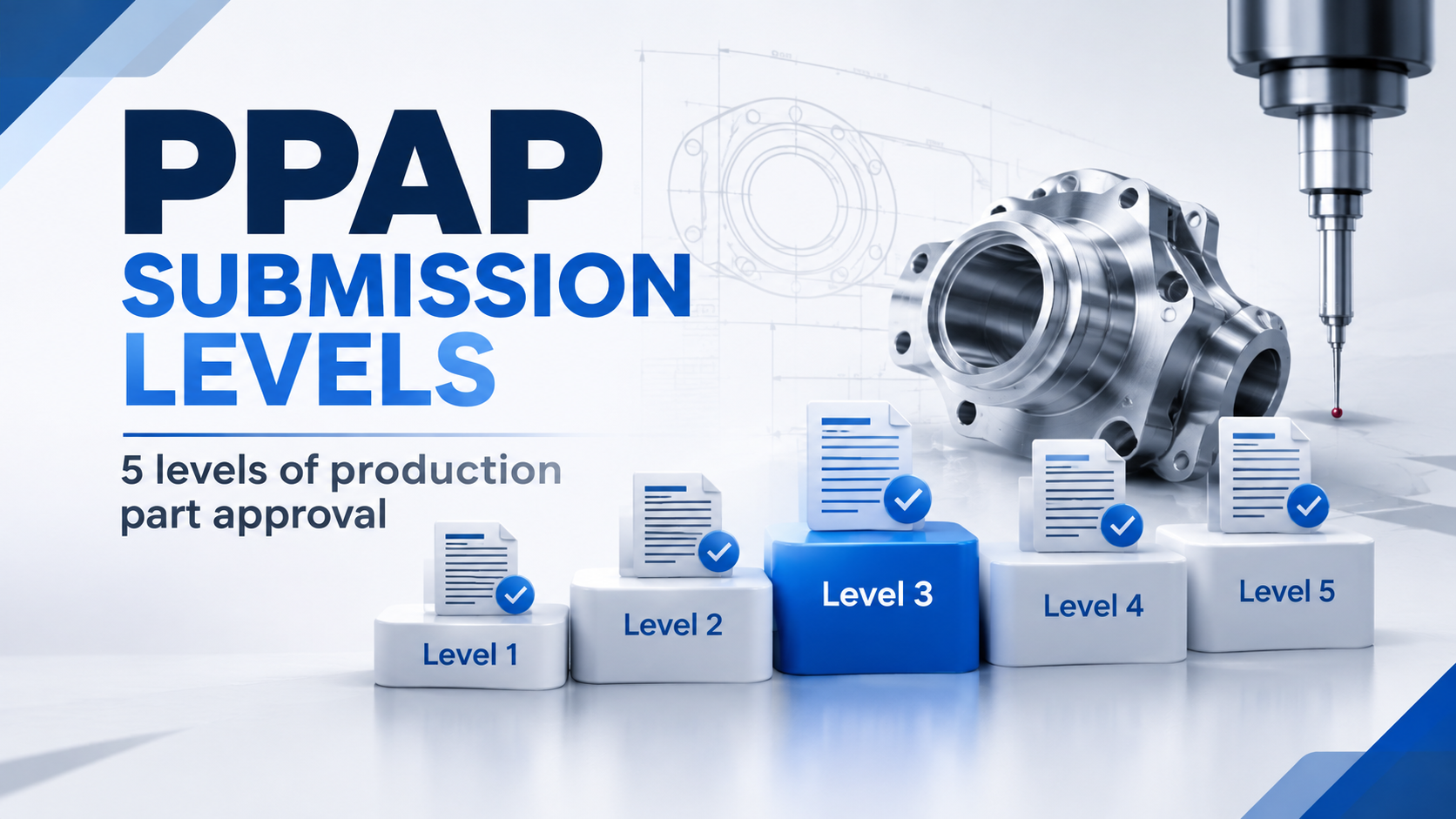
PPAP, the Production Part Approval Process, runs this part approval process on top of APQP: five levels and 18 elements.
Level 3 is the common default for new parts; Level 5 is reserved for safety-critical parts. The 18 elements run from design records through DFMEA, the process map, a risk analysis, the quality plan, dimensional results, and the Part Submission Warrant.
In short: APQP is the process a buyer evaluates throughout the program. PPAP is the checkpoint where a supplier proves that process produces a conforming part.
How APQP Works for Low-Volume and Prototype-to-Production Projects
A complete automotive APQP program, with five phase gates and a formal part-approval submission, is built around high-volume tooled production. Low-volume runs and prototype to production work still benefit from the same thinking, scaled to actual risk and volume.
For a short run, that approach usually compresses: a lighter process flow chart, a risk analysis focused on the few steps that genuinely carry risk, and a plan with only the characteristics that matter most.
DFM belongs here early, during what would be APQP Phase 2 on a longer program, since catching a wall-thickness or draft-angle issue on a prototype is cheaper than on a tooled part. Why DFM matters is exactly this: a manufacturability review before the geometry is locked.
Once a part reaches a steady cadence, buyers placing repeat orders should expect the team to formalize whatever was informal during prototyping: a documented quality plan and consistent inspection records.
What Buyers Should Ask Suppliers About Their APQP Process
A supplier that talks about APQP in the abstract differs from one that can show the documents. Before committing a new part, ask:
- Can you walk through your process map and PFMEA for a part like mine?
- What does your control plan monitor, and how often?
- Has a measurement check been run on the gauges measuring my critical dimensions?
- What PPAP level do you default to, and can you show a completed PSW?
- How does corrective action on a nonconformance reach the next program?
- Are you certified to the IATF standard, with the team given formal APQP training?
A supplier's answers say more about actual quality assurance than a certificate on a wall.
How Amuse3D Plans Quality and Inspects Parts
Amuse3D runs our quality system to ISO 9001:2015 and IATF 16949:2016, applying APQP standards and measurement system analysis as routine practice, not a one-off for certain customers only.
Every inspection gauge is backed by MSA before its readings are trusted.
For dimensional verification, Amuse3D uses a Video Measuring Machine (VMM) and a Coordinate Measuring Machine (CMM), alongside glossmeters and UV inspectors for finish checks. Every delivery includes a signed inspection report against CAD, with material test certificates travelling with the parts.
That combination is the same logic as APQP applied across CNC machining, injection moulding, and MJF 3D printing, whether the program is a single prototype or a repeat run. Read more on why trust Amuse as a manufacturing partner.
Conclusion
APQP is not a document filed once and forgotten. Across the entire APQP process, a supplier should be able to show that chain before the production process is finalized.
Amuse3D runs that same discipline, spanning product development and manufacturing, out of its 50,000 sq ft Oragadam facility near Chennai, for over 1,000 clients across 30+ countries.
That discipline is why Amuse3D holds a 99% on-time delivery record with 0 PPM rejection, the kind of consistency OEMs running vehicle production programs depend on, and it scales the same way down to low-volume manufacturing runs.
Contact us to discuss your part's quality plan, or get instant quote to start a program with that process behind it.
Frequently Asked Questions
1. What does APQP stand for?
APQP stands for Advanced Product Quality Planning, a process for planning product and process quality before production starts. AIAG developed it as one of the five core tools, alongside FMEA, MSA, and SPC.
2. What is the difference between APQP vs PPAP?
APQP is the ongoing process covering the product quality plan, the risk review, and the process map. PPAP is the formal submission, usually at the end of APQP Phase 4, where the maker proves a part meets every requirement using a Part Submission Warrant.
3. Does a low-volume or prototype order need the complete program?
A complete five-phase program with a formal part-approval submission is built for high-volume tooled production. Low-volume and prototype work benefit from the same logic, scaled down: a focused risk analysis, a lighter plan, and an early DFM review.
4. What is a control plan in APQP?
A product quality plan lists what gets measured on a part, how often, with what tool, and the action to take if a reading falls out of specification. It is built from that risk analysis's highest-risk items.

