

MJF printing cost depends on how efficiently each build uses machine volume, the amount of material consumed, and how many parts share that build. The rewritten post below keeps the original structure while focusing more on cost drivers, clarity, and user value, with fewer brand-centric references.
Transparent MJF Printing Cost Explained
When evaluating mjf printing cost, understanding how prices are calculated helps you plan your 3D printing project more confidently and avoid surprises in your budget. This guide breaks down the main factors that influence MJF 3D printing cost so you can better compare quotes, calculate the price for your part, and choose the right 3D printing service for your needs.
This costing approach is driven by capacity and operations: the number of builds run daily, the number of printers, operational efficiency, and overheads. A clear view of these elements makes it possible to offer a price structure that remains competitive while maintaining reliable quality.
Being certified and aligned with industrial standards for Multi Jet Fusion technology also helps keep overall cost per part low without sacrificing strength or accuracy.
Key Factors That Affect MJF Cost
For MJF 3D printing, pricing is primarily determined by the size and geometry of the part rather than abstract “complexity.” What matters most is the space your object occupies in the build chamber, the material selected, the finish, and the number of parts in your 3D model or STL file.
Beyond this, internal cost calculations typically account for:
- Material and powder usage
- Machine time and energy
- Labor for setup, depowdering, and post-processing
- Packing and forwarding
- Other overhead and maintenance factors
Because so many variables interact, rule‑of‑thumb tables often fail to reflect true MJF printing cost and can easily mislead users. A more accurate approach looks at volume, packing density, and production mode rather than just listing a flat price per cc.
Before diving into pricing methods, it is important to understand the single most critical parameter that determines whether a build is cost‑efficient or not: packing density.
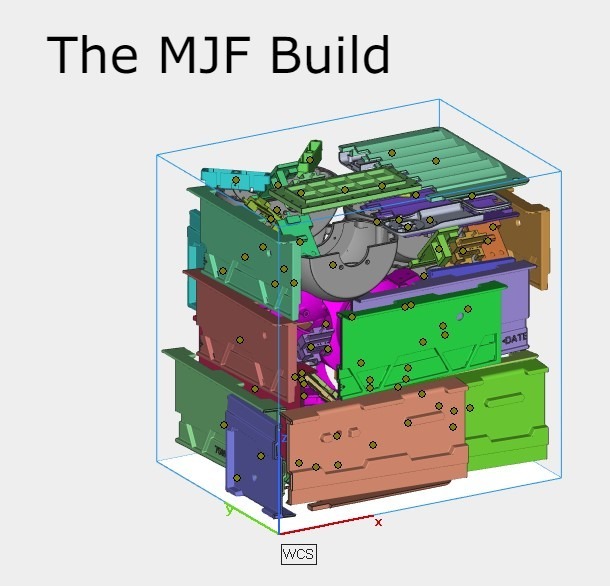
Packing Density in MJF 3D Printing
Packing density is the proportion of the build volume that is actually filled with printed parts inside the Multi Jet Fusion printer’s build chamber. In practical terms, it measures how tightly parts are nested or stacked in 3D space so that a full build uses the maximum amount of material and machine time effectively.
A higher packing density means:
- More parts per build, sharing the same machine cycle
- Less unused powder and therefore lower material waste
- Better use of printer capacity, which reduces cost per part
This has a significant impact on MJF printing services and cost because each build has fixed elements (machine warm‑up, fusion cycle, cooling, labor) that get “spread” over all parts in the chamber. When the chamber is efficiently packed, the overall cost per unit falls sharply, which is why batch production often looks more economical than single‑part jobs.
In summary, packing density in MJF 3D printing is a direct measure of how effectively the build volume is used to reduce material waste, shorten production time, and optimize cost per object.
This guide uses three practical pricing approaches that reflect how packing density and volume influence MJF printing in real projects.all3dp
Method 1: Bounding Box–Based Costing for High-Mix, Low-Volume Work
This first method is ideal for high‑mix, low‑volume parts and prototype runs where each 3D model may have different shapes and sizes. The calculation takes into account both:
- The actual part volume (in cc)
- The bounding box volume—the minimal cuboid that encloses the part in X, Y, and Z
By combining these two values, the method handles builds with varying packing densities while still assigning a fair cost to each part. This is especially useful when multiple small parts and a few larger ones share the same build volume.
Conceptually, the costing model can be seen as:
- Part volume cost = A × (part volume in cc)
- Bounding box volume cost = B × (bounding box volume in cc)
For example, imagine a part with:
- Part volume: 250 cc
- Bounding box volume: 1000 cc
If A is set at INR 36.00 per cc and B at INR 1.00 per cc, the estimated manufacturing cost becomes:
- Part volume portion: 250 × 36 = 9,000
- Bounding box portion: 1000 × 1 = 1,000
- Total = INR 10,000.00
This type of structure naturally favours smaller, thicker parts, which tend to occupy less empty space within the bounding box. Larger, thinner parts that consume more build volume relative to their material mass incur higher cost because they reduce packing efficiency for the entire build.
The A value is influenced by:
- Raw material price changes
- How often additional builds are run (which affects CAPEX amortization)
- Overheads such as labor, maintenance, and energy
The B value remains comparatively stable because it represents the base cost of occupying volume in the build chamber. When builds are carefully planned using multiple MJF systems and auxiliary build units, the variable A can be kept lower than typical market ranges, which is why well‑optimized operations often achieve better per‑part pricing.
Method 2: Direct Volume-Based Costing for Batch Production
The second method works best for similar parts in batch production, such as catalogue components or application‑specific products where geometry and volume are consistent. Here, the MJF printing cost is a straightforward multiplication of part volume (in cc) by a fixed cost per cc.
In simplified form:
- Part cost = (A + B) × (part volume in cc)
Depending on the packing density, the effective cost may range between INR (A + B) per cc and INR B per cc, where:
- B reflects the lowest achievable fixed cost under high packing density
- A accounts for the penalty when packing density drops below an efficient threshold
High‑density jobs (for example, at or above 10% packing density) may use only B, delivering the lowest possible cost per cc. Lower‑density jobs add A on top of B to compensate for underused machine volume.
Consider a part with:
- Volume: 250 cc
- Quantity: 20 units
At a 10% packing density and a base B of INR 36.00 per cc, the total cost for the batch can be estimated as:
- Qty × (A + B) × part volume
- 20 × (A + 36) × 250
If packing density is at or above the target, A is minimized or zero, pulling the per‑unit price down. When packing density is below 10%, A may climb up to a maximum of around INR 25.00, which increases the cost but reflects the reality that the build chamber is not being fully utilized.
This pricing pattern makes direct volume costing very suitable for repeatable industrial parts, where design, volume, and production schedule stay relatively stable over time.
Method 3: Full Build–Based Costing for Contract Manufacturing
The third method is full build–based costing, often used in contract manufacturing arrangements where a customer effectively rents the entire build volume. In such cases, a fixed cost is charged per build, typically based on a packing density window—commonly between 6% and 10%.
Any job whose packing density falls within that band is extrapolated to determine the build cost. This approach is especially attractive for OEMs and industrial users who:
- Have high‑volume requirements
- Prefer not to invest in their own HP Multi Jet Fusion machines
- Want predictable pricing per build rather than per part
Here, whether the build contains prototypes, end‑use parts, or a mix of both often does not affect the fixed build price, as long as the agreed density and build parameters are met. This method is used less frequently than the other two, but it can be a powerful option when production volumes are consistently high and a professional, outsourced solution is preferred.
Production Speed: Standard, Economy, and Expedited Options
Lead time also has a direct influence on mjf printing cost because faster delivery usually requires dedicated builds or priority scheduling. Typical options include:
- Expedited production: Lead times as short as 24 hours, often with a modest premium (for example, around 10%) added to the standard price to account for emergency scheduling.
- Standard production: A balanced option with lead times around 3–4 days, suitable for most projects.
- Economy production: A cost‑saving mode where jobs are grouped and scheduled for maximum packing efficiency, usually with 5–6 day delivery and an extra discount (often 5–10%) for being flexible on timing.
Choosing between these options depends on how urgent the project is, how many parts are in the order, and whether the priority is price, speed, or a balance of both. Discussing these parameters clearly with a 3D printing service provider helps align cost, quality, and delivery expectations from the start.
Note: Cost calculations often assume that parts occupy up to two full MJF builds (for example, 380 mm × 284 mm × 380 mm) and include a standard blasting or dark smoke finish as part of the post‑processing workflow.
Bringing It All Together: Understanding Your MJF Printing Cost
A transparent view of mjf printing cost comes from breaking down the pricing into its main components: material, machine operation, labor, print volume, design geometry, production mode, post‑processing, and overhead. By applying one of the three methods—bounding box‑based costing, direct volume costing, or full build‑based costing—you can more accurately estimate how much your project will cost and why.
Multi Jet Fusion is often a cost‑effective technology for both prototypes and production parts because it offers:
- High part strength and repeatable quality
- Tight nesting and high packing density
- No need for support structures, unlike some laser‑based techniques
Understanding how parts are 3D‑nested and oriented in the build can reveal additional savings, since smart nesting strategies reduce the amount of material needed and improve packing density without compromising mechanical performance.
For larger orders, many industrial 3D printing services offer volume discounts sometimes up to 20% or more as piece price decreases when more units share the same build volume and fixed costs. When comparing quotes, it is wise to look beyond the headline price per part and consider factors like material type (such as PA12 polymer), surface finish, strength requirements, and delivery speed.
If you are planning your next project and want to calculate the price of MJF 3D printing more precisely, sharing your 3D model, target quantities, and desired lead time with a professional service is the most reliable way to receive an accurate, application‑specific quote.

.png)